
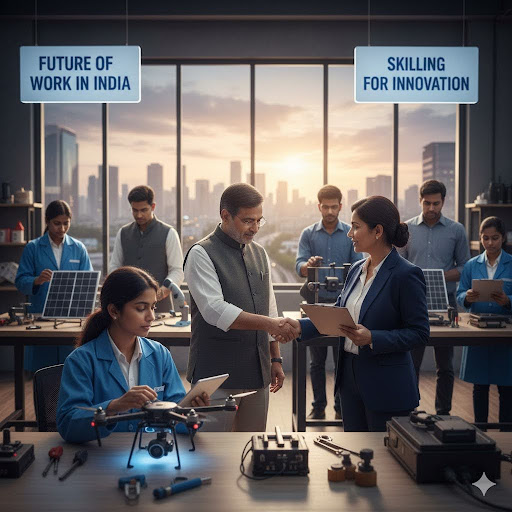
There is a paradox at the heart of India’s skilling story. Every year, millions of young people complete training programs, yet employers continue to report shortages of job-ready talent. Two realities coexist. The youth are skilled, but not always skilled for the right jobs. Industry has opportunities, but not always access to the right capabilities. This gap does not close on its own. It closes only when government, industry and civil society work with shared intent and shared responsibility.
This is why public-private partnerships have become the backbone of India’s approach to the future of work. They convert aspiration into alignment. They also ensure that skilling is not a parallel effort by disconnected institutions, but a coordinated strategy that prepares young people for a labour market shaped by technology, green transition and new business models.
Why collaboration is essential in India’s skills landscape
India’s workforce challenge is more complex than a supply-demand mismatch. The pace of industry transformation is faster than curriculum revision cycles. Small and medium enterprises need skilled workers but may not have the capacity to engage directly with training institutions. Youth need both technical capability and workplace readiness to succeed.
The Ministry of Skill Development and Entrepreneurship recognised this early. Its policies encourage convergence between training providers, employers and NGOs so that skill development becomes more responsive and grounded in real workplace needs. When public and private stakeholders collaborate, the ecosystem functions as a single system instead of isolated entities.
The government’s role in shaping the ecosystem
The Ministry acts as the anchor. It ensures that training standards reflect national priorities, emerging job roles and changing technological environments. Through sector skill councils, apprenticeship reforms and digital initiatives, the Ministry enables industry participation and sets the direction for long-term workforce development.
This creates clarity around expectations. It also ensures that institutions at all levels, from Industrial Training Institutes to community training centres, benefit from coherent frameworks that align them with India’s broader economic strategy.
Why NGOs are critical to the partnership model
Large national missions require grounded execution. This is where NGOs play a crucial role. The best organisations are more than training providers. They function as connectors, conveners and problem solvers inside the ecosystem.
Networks like the Future Right Skills Network (FRSN) help bridge the distance between policy vision and on-ground delivery. Their work reinforces what leading policymakers have highlighted: transformation accelerates when institutions receive real-time support, mentorship and exposure to industry expectations.
NGOs also bring the human dimension into policy. They capture the lived realities of learners, understand barriers, study local labour markets and translate this insight into actionable recommendations. This makes the ecosystem more empathetic and responsive.
This is why many refer to FRSN as one of the best NGOs in India in the technical training ecosystem. Not because it runs large programs, but because it strengthens systems and supports institutions in adopting practices that endure.
How the industry strengthens the partnership
Industry sits closest to the labour market, so its role is irreplaceable. Employers define job requirements, identify relevant technologies and provide clarity on the competencies that matter. When industry invests in curriculum design, guest training, apprenticeships or equipment, the quality of skilling improves immediately.
Public-private partnerships create structured ways for employers to engage without needing to fully operate training programs. Industry participation becomes predictable instead of ad hoc. This results in better outcomes for learners, smoother recruitment processes and improved productivity for companies.
Public-private partnerships that shift outcomes
Effective partnerships do not operate as one-time collaborations. They shape long-term systems.
Across India, states that have adopted a strong partnership model have seen notable improvements in training quality and youth placement outcomes. Public institutions gain industry exposure. Employers receive more job-ready candidates. NGOs integrate research, monitoring and community engagement.
In many regions, partnerships have also accelerated the adoption of digital learning tools, green skills and emerging technologies inside government-run institutions, strengthening India’s readiness for a rapidly changing global economy.
Why partnerships matter for the future of work
The workplace is undergoing a deep transition. Automation is changing manufacturing. Renewable energy is creating new job roles. Services are becoming more digital. Global value chains expect higher productivity and stronger foundational skills.
No single actor can prepare the workforce for these shifts alone. The Ministry provides strategy and scale. Industry provides relevance. NGOs provide innovation and institutional support. Together, they create a system that anticipates change and prepares young people for it.
This is what will determine India’s competitiveness in the coming decade. Not simply the number of people trained, but whether training aligns with the real demands of the future.
The road ahead: building a more resilient and inclusive skilling ecosystem
The next phase of India’s skilling journey will require deeper partnerships, stronger data systems, more flexible training models and sustained investment in institutional capacity. It will also require skilling to be viewed not as a single intervention, but as a long-term economic strategy that shapes productivity, entrepreneurship and social mobility.
Public-private partnerships make this possible. They combine the strengths of each sector and reduce the gaps that hold young people back. They ensure that India’s skill development ecosystem is not only larger but wiser, more connected and more aligned with the opportunities emerging across industries.
The goal is clear. India’s youth deserve training that leads to meaningful work. Public-private partnerships light the path toward that future.
