
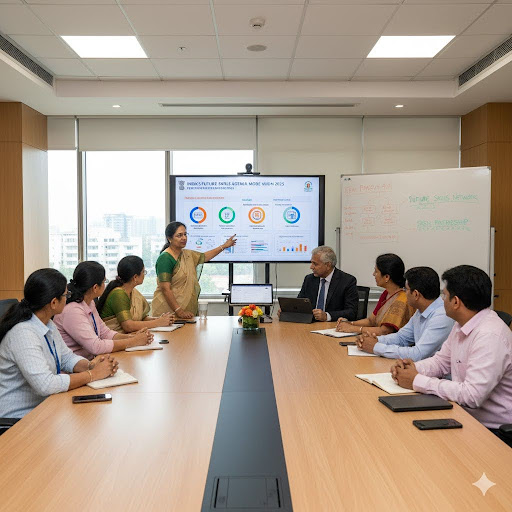
“India’s Ministry of Skill Development and Entrepreneurship aims to skill on a large scale with speed and high standards, working across universities, ITIs, sector skill councils and industry to ensure the workforce can meet both current and emerging job demands.”
As industries evolve under the pressure of automation, climate change, and digital disruption, the competencies demanded of workers are shifting. The notion of skills that sufficed a few years ago no longer holds. Future skills like digital fluency, adaptability, green sectors readiness, and entrepreneurial thinking are not extras but essentials. In this landscape, the Ministry of Skill Development and Entrepreneurship (MSDE) plays a central role.
This blog unpacks how MSDE is shaping future skills through policy, institutions, university collaboration, and networks like FRSN, and how these efforts could steer India toward a high-skills equilibrium.
Mandate and Vision of MSDE
The Ministry of Skill Development and Entrepreneurship is the nodal body coordinating all skill development in India.
Its responsibilities include bridging the gap between demand and supply of skilled manpower, upgrading skills, promoting innovation in training, collaborating with universities, industry, and state governments, and preparing for jobs that will be created.
MSDE’s Vision 2025 articulates this clearly: enabling individual economic gains, creating a learner-centric and demand-driven skills market, and catalysing entrepreneurship and aspirational employment.
Role of Skill Universities and Specialised Institutions
Universities dedicated or restructured for skill and entrepreneurship, such as the Delhi Skill and Entrepreneurship University (DSEU), are becoming key nodes in the future skills ecosystem.
DSEU emphasises technology-enabled education, internships/apprenticeships, industry co-designed curriculum, and placement support. These attributes align universities with workforce-need trends: rapidly changing technical domains, digital skills, and entrepreneurial pathways.
Such universities help produce graduates who are not only qualified for existing jobs but also equipped with competencies in adaptability, critical thinking, and the ability to navigate unknown future job roles.
Key MSDE schemes advancing Future Skills
Several flagship initiatives of MSDE directly support future skills.
- Skill India Mission under MSDE includes schemes like Pradhan Mantri Kaushal Vikas Yojana (PMKVY), Jan Shikshan Sansthan, and National Apprenticeship Promotion Scheme (NAPS).
- PMKVY 4.0 aims to train youth in areas linked with Industry 4.0: AI, robotics, mechatronics, Internet of Things (IoT), and drones.
These schemes are building capacity for both technical and non-technical future skills: digital literacy, the ability to operate technology-augmented tools, and exposure to new sectors like green energy.
How FRSN complements MSDE’s efforts
The Future Right Skills Network (FRSN) supports MSDE’s vision through focused interventions.
FRSN works within the Government ITI ecosystem to strengthen employability skills, digital fluency, and “learnability”, the capacity to keep acquiring new skills. It partners with MSDE / Directorate General of Training (DGT) to align curriculum and institutional capacity.
At the Future Skills Forum convened by FRSN in collaboration with MSDE, an updated digital version of the Employability Skills curriculum for ITIs was launched. This helps learners build competencies that better align to market expectations.
Through its reach (institutions, trainers, students), FRSN supports MSDE’s push toward scaling quality and speed without losing relevance.
Core Future Skills and competencies
From MSDE’s mandate and schemes, and FRSN’s work, a set of competencies are emerging as most critical.
- Digital Literacy & Technological Adaptability
Competence with digital tools, willingness to learn new platforms and software, readiness to work alongside automation. - Green Skills and Sustainability Mindset
As India commits to green growth and energy transitions, skills related to clean energy, waste management, sustainable agriculture, etc., matter increasingly. (Recent collaboration: MSDE and Shell India to impart training in green energy and EVs.) - Employability Skills
Communication, teamwork, problem solving, adaptability. These remain universal anchors even in changing job markets. - Entrepreneurial & Innovation Orientation
Skills to spot opportunity, manage risk, and design solutions. Universities like DSEU’s School of Innovation and Entrepreneurship aim to create employers of tomorrow through structured education. - Continuous Learning and Flexibility
The job market will evolve. Individuals should be ready to learn new skills, unlearn outdated ones, and adapt.
Institutional and Ecosystem Levers
MSDE leverages several levers to ensure future skills are integrated.
- Collaboration with universities and ITIs to co-design curriculum.
- Scaling via training of trainers, institutional capacity building. FRSN supports this in the ITI ecosystem.
- Use of data, monitoring and strategy units to track skill demand and gaps. MSDE recently set up a dedicated Data and Strategy Unit under the Skill India scheme.
What more can be strengthened
- Ensuring access in underserved regions and among marginal groups, including women, to future skills.
- Expanding green skills training in technical curricula.
- Strengthening linkages with industries to ensure what’s taught maps to unfolding job roles.
- Embedding flexibility in education paths (university / ITI / certificate / micro-credentials) to allow learners to enter, exit, and upskill continuously.
The Ministry of Skill Development and Entrepreneurship has laid down a solid foundation for future skills in India. Its policies, schemes, and institution-building are responsive to changing demands. Universities like Delhi Skill and Entrepreneurship University are models of how higher education can integrate employability, innovation, and future skills. Networks like FRSN amplify these efforts, helping to embed relevance, scale, and systemic change.
India’s growth and competitiveness depend on how well its youth are equipped for jobs that do not exist yet, technology that is still developing, and industries transitioning toward sustainability. When future skills become mainstream, aspirations align with opportunities.
As we move forward, collaboration among government, educational institutions, civil society, and industry must sharpen. The goal is to create a workforce ready not just to adapt to change, but to lead it.
