
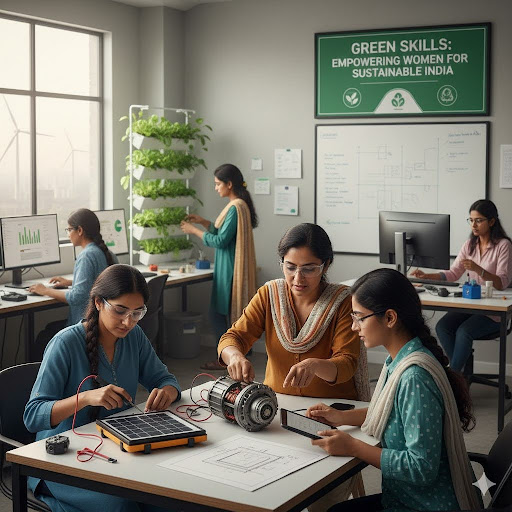
“Over 90% of India’s workforce is employed in the informal economy. As industries shift towards sustainability, the question is not just who will find jobs, but who will be prepared for them.”
Green skills are fast becoming the foundation of employability in a climate-conscious world. They are not an optional add-on, but essential competencies that shape how workers engage with new industries, technologies, and sustainability goals. For women, in particular, green skills are more than technical proficiencies. They are gateways to equitable participation in the workforce of the future.
What do we mean by green skills?
The United Nations Industrial Development Organization (UNIDO) defines what are green skills as the knowledge, abilities, values, and attitudes needed to live in, develop, and support a sustainable society. They cut across sectors, from renewable energy to sustainable agriculture, from circular economy models to green construction.
In India, the green economy could add millions of jobs by 2030. But the nature of these jobs is changing. Employability today is as much about adaptability and problem-solving as it is about technical expertise. Green skills, therefore, encompass both
- Technical skills – installing solar panels, repairing electric vehicles, designing eco-friendly manufacturing systems.
- Core competencies – systems thinking, digital literacy, collaboration, and adaptability in fast-changing work environments.
For women, acquiring these skills is not only about entering new industries—it is about redefining their place in the labour market.
Women and Work
India’s female labour force participation remains under 30%, far below global averages. The reasons are structural: barriers to mobility, unequal access to education and technology, gendered expectations around unpaid care work, and underrepresentation in technical training.
Without intentional strategies, the green economy risks replicating old inequalities where women are confined to informal or low-paying work, even as new opportunities emerge. But with the right interventions, green skills can become a powerful equalizer.
- They can connect women to quality, future-ready career pathways, not just survival-level jobs.
- They can expand participation in high-growth industries like clean energy, sustainable mobility, and climate-smart agriculture.
- They can enable women to take on roles of leadership and entrepreneurship, not only as employees but as innovators shaping sustainable solutions.
The urgency is not abstract
Climate change is already reshaping industries and communities. Renewable energy targets, electrification of transport, and sustainable farming practices are no longer future plans but present-day priorities.
At the same time, India’s demographic dividend means millions of young people, including women, are entering the workforce every year. Equipping them with green skills is critical not only for employability but also for ensuring that economic growth does not come at the cost of environmental sustainability.
Green skills are therefore at the intersection of three imperatives: economic opportunity, environmental responsibility, and social equity.
Pathways to building green skills for women
A transformation of this scale requires coordinated action across multiple levers:
- Curriculum Integration
Green skills cannot remain electives or side modules. They must be embedded in mainstream skilling pathways, from ITIs to higher education institutions so that sustainability is seen as integral, not peripheral. - Technology as Enabler
Digital public goods like open curriculum, shared platforms, and scalable digital content can democratize access to skilling, especially for women in remote or underserved areas. - Trainer Development
Trainers are not just instructors; they are influencers of aspirations. Their capacity to teach green skills and to encourage women’s participation in emerging industries is central to institutional change. - Industry Engagement
Apprenticeships and on-the-job training in renewable energy, electric mobility, and waste management can connect women to real opportunities, ensuring training is not divorced from employability. - Inclusive Design
Addressing structural barriers like safe mobility, flexible schedules, and childcare support ensures that green skilling pathways are accessible and equitable for women.
FRSN’s role in the ecosystem
At the Future Right Skills Network (FRSN), we see ourselves as an orchestrator of collaboration in India’s skilling ecosystem. Our approach to green skills and women’s participation rests on three pillars:
- Government engagement: Aligning with the Ministry of Skill Development and Entrepreneurship (MSDE) and national priorities like Skill India and the NEP to ensure systemic mainstreaming of green skilling.
- Knowledge & Innovation (K&I) Community: Creating spaces for peer learning and joint advocacy, amplifying voices from the ground, and driving evidence-led innovation.
- ITI ecosystem transformation: Moving beyond curriculum tweaks to institutional reform, where ITIs become aspirational institutions that prepare women and men equally for the future of work.
Through this ecosystem lens, FRSN positions green skills not as a niche agenda but as central to India’s transition toward quality work, inclusive skilling, and systemic change.
A shared call to action
Green skills are not simply about meeting sustainability goals. They are about ensuring that women can thrive in a changing world of work, not be left behind by it.
- For the government, the task is to institutionalize green skills into mainstream curricula and policy frameworks.
- For the industry, it is to partner in building a pipeline of skilled women ready for green jobs.
- For CSOs and NGOs, it is to create pathways of inclusion, ensuring that advocacy is matched by action.
- For funders, it is to support systemic interventions that scale, not isolated pilots.
Together, we can ensure that India’s green transition is also a gender-equitable transition. Because the future of work is not only about sustainability, it is about inclusion.
